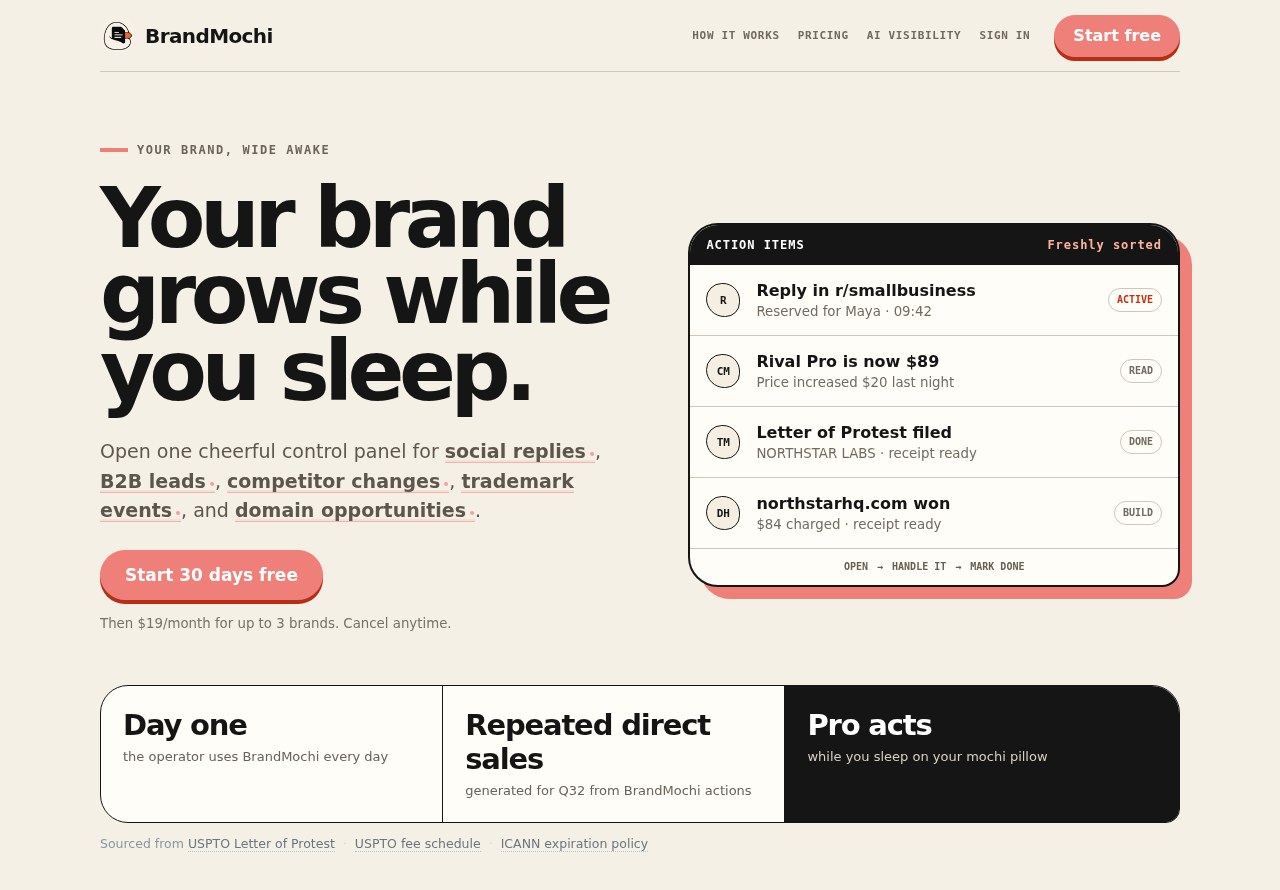
Turn scattered signals into one working queue
The earliest tools each answered a useful question. Where is a relevant public conversation? What changed on a competitor’s site? Is a similar trademark application moving through examination? Which brand-adjacent domain is becoming available? Separate reports made those signals visible. They also created separate inboxes, decisions, and follow-up habits.
The central product decision was to give every finding the same operational shape: a source, enough context to judge it, a reason it may matter, an owner, a state, and a next action. The public BrandMochi control panel now describes one queue for social replies, B2B leads, competitor changes, trademark events, domain opportunities, and LLM visibility work. A teammate can open an item, reserve it while working, act, and leave a completion record.
This action model gave the combined product a coherent center. The monitors could keep their subject-specific logic while feeding the same daily workflow. The how-it-works guide explains the loop in plain terms: teach the product about the brand, work the queue, and choose how notifications arrive. That loop also gave onboarding and empty states a concrete destination—the first useful actions for a real brand.
Use a shared action model with specialized evidence
At a high level, BrandMochi is a multi-tenant application with brand and team context, monitoring jobs, normalized findings, an action workflow, notifications, billing, and controlled automation. Monitoring sources run on their own cadence. Findings are matched to the relevant brand, enriched with source evidence, deduplicated where appropriate, and turned into queue items. The product records assignment, reservation, approval, completion, and history around those items.
The evidence varies by monitor. Social monitoring links teammates to the original public conversation and prepares an editable reply suggestion with an ordinary disclosure. Competitor and brand monitoring captures public pricing, terms, positioning, and similar-brand signals so a team can compare the previous and current state before deciding whether to respond.
Trademark work starts with public records. The USPTO Open Data Portal provides the official data surface, while the USPTO’s Letter of Protest guidance explains that a protest must present a relevant legal ground and supporting evidence concerning a pending application. BrandMochi’s trademark monitor brings possible matches and their evidence into review; legal judgment and escalation remain explicit parts of the workflow.
Domain opportunities have their own timing and cost constraints. The domain monitor evaluates brand fit, prior site history, and a possible job for the domain. ICANN’s expired registration policy overview is a useful reminder that expiration, renewal, grace periods, and deletion are distinct stages. The queue needs the relevant stage, deadline, source, and spending boundary before an acquisition action is useful.
Coordinate people before increasing automation
Team coordination arrived early because a good opportunity can become awkward when two people reply, two buyers bid, or an unreviewed legal action moves forward. BrandMochi uses short reservations for active work, assignment for durable ownership, and a shared history after completion. Mobile support matters here: the person handling a timely reply or approval may be away from a desk.
Automation follows the same action model and respects a narrower authority. The system can prepare work broadly; execution depends on saved rules, roles, approval state, and cost ceilings. A social draft stays editable and human-published. A filing or purchase can wait for approval. Pre-authorized actions remain inside explicit limits. The public security and automation controls describe the place users review those boundaries.
These controls are product behavior as much as security behavior. The interface should show what will happen, why it is allowed, what it may cost, and how to stop it. Logs and notifications need enough attribution to answer whether a teammate, a scheduled job, or an approved automation handled an item. Clear attribution made live operation easier to support and gave the team a useful way to refine messaging when users misunderstood an action.
Expand from protection into measurable growth work
Once the queue could organize defensive monitoring, it also provided a home for growth work. Lead Finder researches matching businesses, keeps links to public contact sources, merges duplicates, and stages leads for review, export, or an outreach campaign. Personalized outreach remains inspectable work with a source and status at every handoff.
LLM visibility measurement added another kind of signal: how a brand appears in answers across a defined set of prompts and how that visibility changes. A score alone has limited operational value, so the useful output is a recommendation the team can evaluate and assign. Public brand profiles and marketing tools can then turn selected findings into pages, campaigns, or follow-up work.
Content actions follow the same evidence-led approach. Google’s guidance on helpful, people-first content asks whether material offers original information, complete treatment, first-hand expertise, and clear sourcing. BrandMochi’s field guides apply a similar practical standard to social replies, competitor decisions, and domain or trademark actions: understand the source, add the team’s real knowledge, and keep the work natural.
Develop against live operations
BrandMochi became a standalone product through iterative use. Onboarding, monitoring reliability, notifications, billing, team workflows, mobile layouts, and message clarity were refined while campaigns ran. Live operation exposed issues that a feature checklist could miss: stale actions, duplicate leads, unclear ownership, weak source attribution, noisy alerts, and recommendations that required too much interpretation before anyone could act.
The architecture supports that learning by keeping monitors separable and actions consistent. A source job can be retried without inventing a second action. A matching rule can be versioned and evaluated against known examples. Queue metrics can show age, completion, reassignment, and dismissal patterns. Structured logs and repair tools can trace a finding from retrieval through matching, notification, and completion. These are the mechanisms that make a multi-source control panel operable over time.
The broader studio lesson is that aggregation becomes valuable when the product owns the handoff into action. A dashboard should help someone decide, coordinate, and finish. BrandMochi’s unified queue gave protection and growth tools a shared operating language, while source links, human review, spending controls, and attribution kept each specialized action understandable.
That foundation leaves room for new monitors without turning every addition into another inbox. A new signal earns its place when it can arrive with credible evidence, identify the appropriate next move, respect team authority, and leave a useful history after the work is done.