Start with the public record
The first version had a narrow purpose: collect public regulatory filings, identify companies moving toward an IPO, and put those names into an accessible grid. The SEC describes EDGAR as its primary system for company submissions under the major federal securities laws, and its public database is free to research. That made EDGAR the right foundation for a product whose credibility depends on being able to return to the original record.
A filing is source evidence, though it is rarely the complete answer to a researcher’s question. An issuer can file an initial registration statement without settled terms, amend it several times, change a proposed ticker or exchange, receive effectiveness, price, postpone, withdraw, and later return. The useful product had to preserve those individual events while also presenting a coherent view of the deal now.
That distinction shaped the early architecture. Source documents and their identifying metadata were retained as evidence. Expected dates, offering terms, ticker hints, exchange plans, and company status were treated as derived information. When the interpretation rules improved, those fields could be rebuilt from the same evidence. Earlier interpretations never had to harden into historical guesses.
Build ingestion, interpretation, and presentation as separate concerns
The product grew in stages: market data, company profiles, news, filing summaries, calendars, historical outcomes, and research tools. Each new surface depended on a repeatable pipeline, so we kept three concerns legible. Ingestion answers what arrived and when. Interpretation answers what an event means for a company or deal. Presentation answers what a researcher needs to see in a grid, profile, chart, article, or machine-readable response.
At ingestion, stable issuer identifiers matter more than display labels. The SEC’s EDGAR APIs provide submissions and XBRL data without API keys, along with bulk archives for larger retrieval jobs. Company names and tickers can drift; a CIK gives the pipeline a durable starting point. Raw filing identity, acceptance time, form type, and source location remain useful even when every later extraction is revised.
Interpretation turns filing sequences into a lifecycle. An S-1 or F-1 can establish a candidate; amendments can revise terms; other forms can supply effectiveness, securities registration, or final prospectus evidence. These events accumulate in sequence. The public IPOGrid data model reflects that progression by joining issuers, filings, extracted terms, outcomes, news, charts, and market bars around the question being researched.
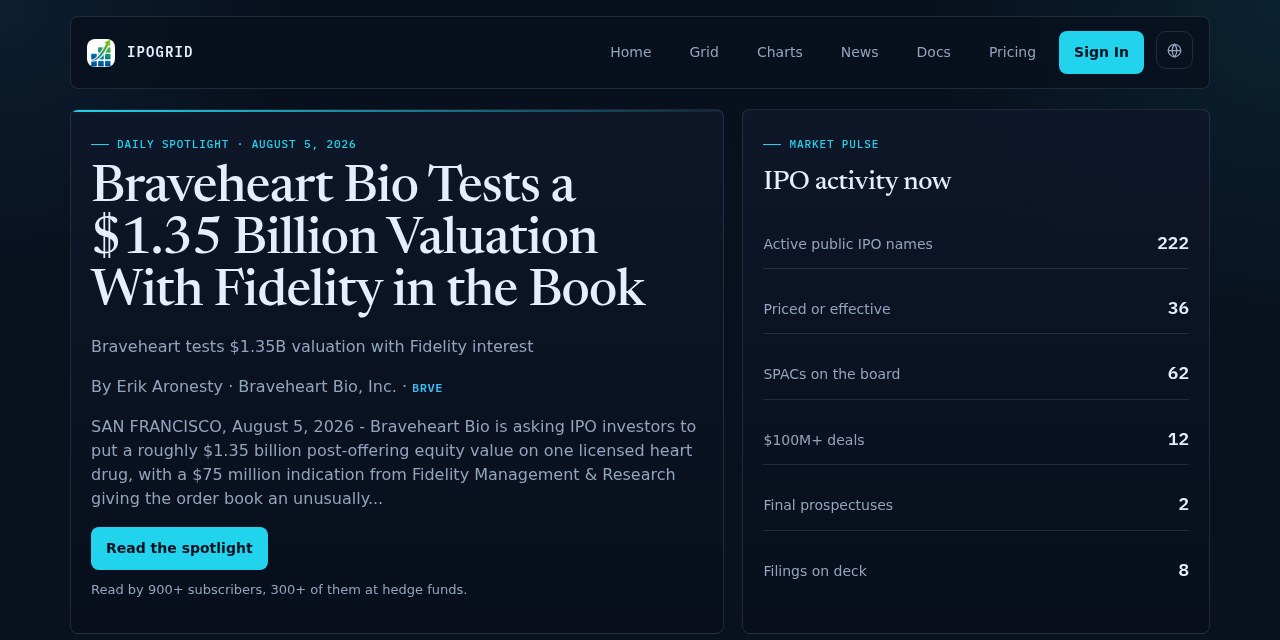
Presentation then serves different levels of attention. The public IPO grid is for scanning active names and current signals. Market charts support aggregate questions about filing activity, proceeds, sectors, and prospectus flow. Company pages and IPO news provide the context needed when a row deserves closer reading.
Model uncertainty as product information
IPO data carries uncertainty that an interface should show plainly. An expected date is a signal with a source, timestamp, and a real chance of moving. A ticker in a filing may be proposed, reused, or associated with a different security class. An exchange plan can change. An issuer can withdraw, remain dormant for years, or return with a new transaction. Hiding those distinctions makes a clean dashboard less trustworthy.
The lifecycle model therefore needs room for the current interpretation, the evidence behind it, and the possibility that the interpretation will change. IPOGrid’s guide to deal screens and cohorts separates active operating-company IPOs from priced names, already-trading securities, follow-ons, SPACs, funds, and other vehicles. That separation prevents a convenient screen from blending deals with materially different structures and outcomes.
Freshness also belongs in the research experience. Filing acceptance, pricing, effectiveness, and first trade run on different clocks. IPOGrid’s freshness and caveats guidance encourages readers to check timestamps and return to the source filing when a number matters. We see that guidance as part of the product design: uncertainty is a fact the system should help a researcher manage.
Make background work bounded and safe to repeat
Dependability became the central engineering work as the product accumulated sources and derived fields. A large catch-up job can monopolize resources, amplify a transient source failure, or leave a half-updated record. The healthier pattern is bounded background work: small batches, explicit queues, limited concurrency, visible checkpoints, and a clear retry path.
Retry safety begins with stable identities and idempotent writes. Seeing the same filing twice should confirm or update the same source event and avoid a second fictional event. Enrichment should be versioned so the system can tell which interpretation produced a field. A failed market-data join should be retryable without re-ingesting the filing timeline. Those boundaries keep a repair local.
Checks compare derived results with evidence. Does the displayed latest filing exist in the issuer timeline? Does a priced status have supporting source material? Is an outcome linked to the intended security and current deal cycle? Tests cover lifecycle transitions and awkward histories; structured logs expose which source, issuer, job, and rule were involved; repair tools can re-run one issuer, one filing window, or one enrichment version. This work is quiet, and it is what makes the visible research surface dependable.
Open the same research model to people and software
The current product exposes the same SEC-first model through several research surfaces. The documentation overview connects company, filing, news, outcome, and chart data. The research workflow guide shows how to define explicit cohorts for watchlists, filing-change review, and post-listing analysis. This keeps a human browsing the site and an analyst building a notebook close to the same concepts.
For applications, the REST API guide covers companies, filings, news, outcomes, charts, and published articles, with a separate interactive API reference for endpoint details. Durable joins use CIK; ticker remains useful for discovery. Asking only for the joins a workflow needs keeps requests and downstream assumptions understandable.
IPOGrid also offers a read-only MCP research connector. It lets compatible assistants find companies, inspect issuer context, retrieve news and outcomes, and create chart data while preserving links back to canonical sources. Read-only access fits the underlying principle: research tooling can accelerate retrieval and comparison while the evidence remains available for verification.
The lasting development lesson is straightforward. Begin with authoritative primary sources. Keep the original evidence. Make interpretation rebuildable, expose uncertainty, and design repairs before the dataset becomes difficult to reason about. That foundation allowed IPOGrid to grow from a useful table into a set of connected research workflows without losing the trail back to the filing.